

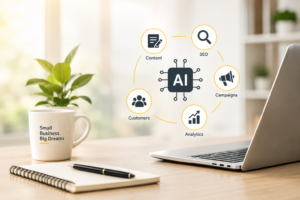
Artificial intelligence is no longer something only large companies can afford or understand. Today, small businesses can use AI marketing tools to create content, understand customers, automate repetitive tasks, improve advertising, and generate leads.
But there is a catch: AI can do a lot, but that does not mean your business needs every AI tool available.
For a small business, the better approach is to start with one or two clear marketing problems and use AI to solve them. This keeps costs under control, saves time, and makes it easier to measure results.
So, where should you start with AI marketing for small businesses?
Let’s break it down.
What Is AI Marketing?
AI marketing means using artificial intelligence to support different parts of your marketing process.
This can include:
- Creating and improving marketing content
- Analysing customer behaviour
- Personalising emails and offers
- Finding audience insights
- Automating repetitive marketing tasks
For example, a local digital marketing agency might use AI to analyse which website pages generate the most enquiries. A retail business could use AI to identify products customers frequently purchase together. A small B2B company might use AI to personalise follow-up emails for different types of prospects.
The important point is that AI should support your marketing strategy, not replace it.
Why Should Small Businesses Consider AI Marketing?
Small businesses often work with limited time, people, and budgets. Marketing teams may consist of one person—or sometimes the business owner themselves.
AI can help reduce some of that workload.
-
Save Time
Creating social media captions, researching topics, analysing reports, and preparing email drafts can take hours.
AI marketing tools can speed up these tasks, allowing your team to spend more time on strategy, customers, and sales.
-
Understand Customers Better
AI can analyse large amounts of marketing data much faster than a person.
It can help identify patterns such as:
- Which pages visitors view
- What content gets engagement
- Which campaigns generate leads
- Which products attract attention
- When customers are most active
These insights can help a small business make more informed marketing decisions.
-
Improve Personalisation
Customers don’t all have the same needs.
A software company, for example, may have different messages for startups, SMEs, and large enterprises. AI can help organise audiences and create more relevant communication for each group.
-
Make Better Use of Marketing Budgets
AI can assist with campaign analysis and audience segmentation. This can help businesses understand which campaigns are performing and where their money may be getting wasted.
It does not guarantee better results, but it can provide useful information for making campaign decisions.
Where Should You Start With AI Marketing?
The biggest mistake is starting with the tool instead of the problem.
Before subscribing to five different AI platforms, identify what is slowing your marketing down.
Here is a practical starting point.
Step 1: Identify Your Biggest Marketing Challenge
Ask yourself:
What marketing task takes too much time or produces inconsistent results?
It could be:
- Writing social media content
- Generating leads
- Following up with prospects
- Creating email campaigns
- Analysing website traffic
Choose one problem first.
For example, if your business struggles to publish consistently on social media, AI content tools could help you generate ideas, captions, content variations, and monthly themes.
Step 2: Start With Content Creation
Content is one of the easiest areas for small businesses to explore AI.
AI can help with:
- Blog topic research
- Content outlines
- Social media ideas
- Email drafts
- Ad copy variations
However, don’t simply publish whatever an AI tool produces.
Add your own experience, examples, opinions, statistics, customer insights, and industry knowledge.
For example, instead of publishing a generic article about “digital marketing tips,” a Pune-based service business could share specific lessons from working with local customers.
That makes the content more useful and more credible.
Step 3: Use AI for SEO Research
AI can also support an AI SEO strategy.
It can help you organise keyword ideas, understand search intent, create content briefs, identify content gaps, and improve existing pages.
For example, instead of targeting a broad keyword such as “digital marketing,” a small agency might discover more specific searches such as:
“digital marketing agency for small business in Pune”
The more specific search may better match the company’s target audience.
Still, keyword research should be combined with real search data and SEO tools. AI-generated keyword suggestions alone should not determine your entire SEO strategy.
Step 4: Improve Lead Follow-Up
Generating a lead is only the beginning.
Many small businesses lose potential customers because enquiries are not followed up quickly or consistently.
AI-powered CRM and automation tools can help organise leads, schedule follow-ups, classify enquiries, and personalise communication.
For example:
A website visitor fills out a form asking about website development.
Instead of leaving the enquiry in an inbox for two days, an automated workflow can immediately acknowledge the enquiry and notify the sales team.
The salesperson can then take over with a personal response.
That combination—automation plus human interaction—is often more useful than trying to automate the entire sales process.
Step 5: Use AI to Understand Marketing Data
Marketing generates a lot of data.
Website traffic. Search impressions. Click-through rates. Social engagement. Ad costs. Leads. Conversions.
AI analytics tools can help identify patterns in this information.
For example, you may discover that one blog receives hundreds of visitors but generates almost no enquiries, while another page with fewer visitors produces several leads.
That changes the conversation from:
“How do we get more traffic?”
to:
“How do we attract the right traffic and convert it?”
That is a much more useful marketing question.
AI Marketing Tools Small Businesses Can Explore
You don’t need dozens of tools.
Depending on your goals, you can explore AI-powered solutions for:
| Marketing Need | How AI Can Help |
| Content | Ideas, drafts, repurposing and editing |
| SEO | Keyword research, content briefs and optimisation |
| Social Media | Post ideas, captions and content planning |
| Email Marketing | Personalisation and campaign drafts |
| Advertising | Copy variations and campaign analysis |
| Customer Service | Chatbots and automated responses |
| Analytics | Pattern detection and reporting |
| CRM | Lead organisation and follow-up automation |
Choose tools based on your workflow rather than choosing them because they are popular.
Common AI Marketing Mistakes to Avoid
AI can make marketing faster, but using it without a strategy can create new problems.
Publishing AI Content Without Reviewing It
AI-generated content can contain incorrect information, outdated claims, or generic examples. Always review important content before publishing.
Trying to Automate Everything
Customers still value genuine conversations. Use AI for repetitive tasks, but keep human involvement where trust and judgement matter.
Using Too Many Tools
More tools do not automatically mean better marketing. Start small and expand only when there is a clear need.
How SmartXStudio Helps Small Businesses with AI Marketing
SmartXStudio helps small businesses turn AI into practical marketing workflows. From SEO and content creation to social media, website optimisation, branding, and digital campaigns, we combine technology with strategy. Instead of using AI simply to produce more content, we focus on using it to improve visibility, engagement, lead generation, and overall digital growth.
Final Thoughts
AI marketing for small businesses is not about replacing your marketing team or handing your entire strategy to a machine.
It is about working smarter.
Start with a real problem. Choose an appropriate tool. Test it on a small scale. Review the output. Measure the results. Then decide whether it deserves a bigger role in your marketing process.
The businesses that benefit most from AI are unlikely to be those that simply use the most tools. They will be the ones that know where AI can genuinely save time, improve decisions, and create a better customer experience.
FAQs
- What is AI marketing for small businesses?
AI marketing involves using artificial intelligence to support activities such as content creation, SEO, customer analysis, advertising, lead management, personalisation, and marketing automation.
- How can a small business start using AI marketing?
Start by identifying one repetitive or time-consuming marketing task. You could begin with content creation, SEO research, lead follow-up, customer analysis, or reporting. Test one suitable AI tool and measure the results.
- Can AI replace a small business marketing team?
AI can automate and support many repetitive marketing activities, but it should not completely replace human strategy and judgement. Human input remains important for brand voice, customer relationships, fact-checking, creativity, and business decisions.
- Is AI-generated content good for SEO?
AI can assist with SEO content, but simply generating large amounts of AI content does not guarantee rankings. Useful content should satisfy search intent, demonstrate expertise, provide original value, and be reviewed for accuracy and relevance.
- How much does AI marketing cost for a small business?
Costs vary depending on the tools and workflows involved. Many businesses can begin with free or low-cost AI tools and upgrade as their requirements grow. The better approach is to evaluate the value generated rather than choosing tools based only on price.


